

Cart
0

Table of Contents
- Quick Comparison: Camp Bed Types at a Glance
- Types of Camp Beds for Camping: Cots, Pads, and Air Mattresses
- Camping Mattress vs Cot: Which Sleep System Fits Your Trip?
- How to Make a Camping Bed More Comfortable
- Portability, Pack Size, and Weight Capacity
- Durability, Materials, and What to Ignore
- Frequently Asked Questions
Last Updated: September 24, 2026
Quick Comparison: Camp Bed Types at a Glance
Choosing camp beds for camping comes down to three systems: cots, sleeping pads, and air mattresses. Each trades weight, comfort, and warmth differently. A cot keeps you off cold ground, a pad packs small, and an air mattress splits the difference. Here is how they stack up before we dig into the details.
| System | Best For | Pack Size | Warmth Source | Setup Time |
|---|---|---|---|---|
| Camp cot | Car camping, bad backs | Large, heavy | Needs a pad on top | 1-3 minutes |
| Self-inflating pad | Backpacking, space limits | Small to medium | Foam plus air | 2-5 minutes |
| Air mattress | Couples, base camp | Medium to large | Air only, loses heat | 3-8 minutes |
This guide breaks down what actually matters: warmth, support, packability, and durability.
Types of Camp Beds for Camping: Cots, Pads, and Air Mattresses
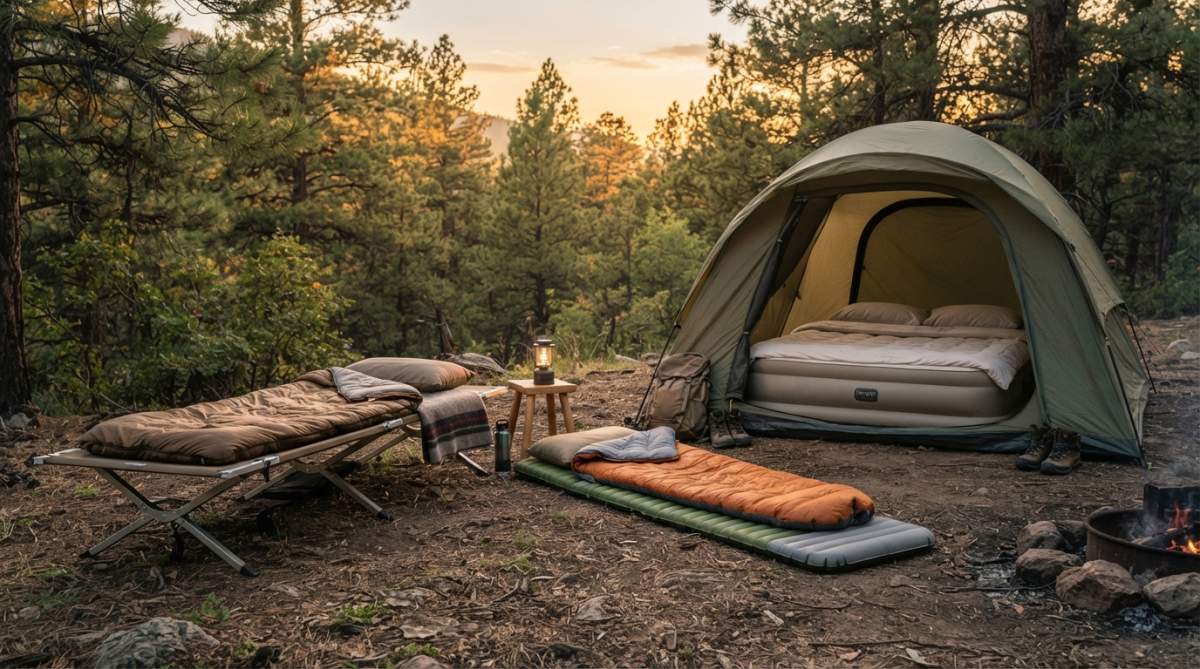
Camp beds for camping fall into three families, and picking the wrong one is the most common mistake first-time buyers make. Camp cots lift you off the ground. Sleeping pads and self-inflating mats sit directly on it. Air mattresses inflate thick but sleep cold. Match the system to your trip, not to the marketing photos.
Camp Cots: Off-Ground Sleeping Platforms
A camp cot is a portable sleeping platform that raises you above the ground on a frame. The main draw is off-ground sleeping: no rocks, no roots, no ground moisture seeping into your bag. Cots suit car camping and base camps where weight does not matter. The trade-off is bulk. Most cots pack larger than a tent and add real pounds to your load.
Sleeping Pads and Self-Inflating Mats
A sleeping pad is a thin insulated layer that goes under your sleeping bag. Self-inflating models combine open-cell foam with an air chamber, so they puff up on their own once you open the inflation valve. These are the go-to choice for backpacking because they hit the best weight-to-warmth ratio. Closed-cell foam pads are lighter and bombproof but less cushioned.
Camping Mattress vs Cot: Which Sleep System Fits Your Trip?
The camping mattress vs cot decision hinges on one question: are you carrying your gear or driving it? Cots win for comfort and off-ground sleeping. Air mattresses win for couples and car campers who want a wide, soft surface. Pads win when every ounce counts.
Here is the honest breakdown:
- Choose a cot if you have back pain, sleep cold, or camp near your vehicle.
- Choose an air mattress if two people share a bed and you want size over warmth.
- Choose a pad if you are backpacking and packability rules everything.
A common mistake is buying an air mattress for cold-weather trips. Air alone offers almost no insulation, so you sleep cold no matter how thick it feels.
Watch Out
An air mattress with no insulation sleeps cold in three-season conditions. The air inside chills you from below, and a thick mattress does not fix that. Pair any air mattress with an insulated pad or a closed-cell foam layer underneath.
How to Make a Camping Bed More Comfortable
Comfort comes from three fixes: warmth under you, support that matches your sleeping position, and the right pillow. Most campers under-insulate their bed and blame the mattress. Get the layers right and a basic setup sleeps better than an expensive one.
Layer for Warmth: R-Value and Insulation Basics
R-value measures thermal resistance, or how well a pad blocks cold from the ground. Higher R-value means warmer sleeping. The temperature rating of your bag only counts if the pad beneath it stops ground cold from pulling heat out of you. For three-season camping, look for a pad with meaningful insulation. For winter or 4-season camping, you want a higher R-value and a cot or pad combo that keeps cold air away.
Ground moisture and airflow matter too. A cot lets air move under you, which helps in heat but hurts in cold unless you add a pad. A closed-cell foam layer under an air mattress is the cheapest way to add warmth, because foam traps still air while the mattress alone just conducts heat away from your body.
Ergonomic Support: Matching the Bed to Your Body and Back
Most guides stop at "firm vs. soft." That misses the real question: does the bed keep your spine in neutral alignment for the way you actually sleep? Ergonomic support means your hips and shoulders stay aligned, not sunk into a soft pocket.
- Side sleepers need a thicker pad or a firm cot surface so the shoulder and hip can sink without bottoming out. On a thin pad, the shoulder compresses to the ground and the spine bends.
- Back sleepers do fine on medium support, but a pad that is too soft lets the hips drop and the lower back arch.
- Stomach sleepers need a firmer, flatter surface; a soft air mattress lets the midsection sag and the neck twist.
For campers with chronic back pain, the priority order changes.
Pillow Pairing and Neck Support
Pillows get skipped, and neck strain ruins a trip faster than a hard mattress. Match loft to your position:
- Side sleepers: high loft to fill the shoulder gap
- Back sleepers: medium loft
- Stomach sleepers: low loft or none
Pro Tip
Inflate a new pad or mattress at home and leave it overnight before your trip. This reveals slow leaks and lets the foam fully loft, so you are not debugging gear in the dark at camp.
Portability, Pack Size, and Weight Capacity
Packability decides which camp beds for camping you can actually bring. Check packed size and weight capacity before you buy, not after. A cot that fits your car but not your trunk is useless.
Matching Bed Dimensions to Your Vehicle and Tent
This is where most buyers get burned. A cot or air mattress that looks compact in photos can still be too long for a trunk or too wide for a tent floor. Measure before you commit.
- Trunk and cargo area: Measure the narrowest opening, not just the floor. A cot packed in its bag is often a long, rigid cylinder, so the limiting factor is usually the diagonal or the height of the trunk lip.
- Roof box and cargo carrier: These add length but have hard width and height limits. Check the internal dimensions, not the external ones.
- Tent floor footprint: A two-person tent is typically rated for two sleeping bags side by side, not two wide air mattresses. A queen-size air mattress can fill a two-person tent wall to wall with no room for gear.
- Tent height: A tall cot plus a sleeper may not clear a low tent ceiling, especially in dome tents with sloping walls.
Weight Capacity and Stability
Weight capacity is a safety spec, not a suggestion. Stay well under the limit for stability, because a cot or pad loaded near its maximum flexes more, creaks, and can tip on uneven ground. Two people on a double air mattress should add both weights and compare to the stated capacity.
Key specs to compare:
- Packed size: does it fit your vehicle or pack?
- Weight capacity: stay well under the limit for stability
- Setup time: cots and pads set up in minutes; some air mattresses take longer
- Footprint: measure your tent floor before committing
- Packed weight: matters for backpacking, less for car camping
Pack Size by System
- Camp cots pack largest and heaviest. They are car-camping gear, not backpacking gear.
- Self-inflating pads pack small to medium and hit the best weight-to-warmth ratio for backpacking.
- Air mattresses pack medium to large and are best for couples and base camps where weight does not matter.
Durability, Materials, and What to Ignore
Durability comes down to fabric denier and puncture resistance. Higher denier means a tougher shell that resists abrasion and tears. For durability testing, look for reinforced seams and a sturdy inflation valve that will not strip or leak.
Key Takeaway
Buy for the specs, not the label. Denier, weight capacity, R-value, and valve quality tell you more about how a camp bed will hold up than any "rugged" claim on the box.
Frequently Asked Questions
What is the best bed to sleep on when camping?
It depends on how you camp. Car campers and taller sleepers usually do best on a camp cot because it keeps you off cold ground and sets up in minutes. Backpackers should choose a self-inflating sleeping pad with an R-value of 3 or higher to save weight and packed size. Weekend campers who want a mattress feel often prefer a thick air chamber pad. Match the bed to your transport, not just your comfort preference.
Are camp beds better than sleeping pads?
Neither wins outright. Camp beds, especially cots, offer more cushioning, stability, and off-ground sleeping that keeps you away from ground moisture and airflow chill. Sleeping pads win on packability and gear weight, which matters on backpacking trips. If you drive to the site, a cot is usually the more comfortable choice. If you hike in, a pad with a solid R-value is the practical pick.
How do I choose the right size camp bed for my tent?
Measure your tent's interior floor first, then subtract a few inches on each side for walls that slope inward. A standard cot runs about 75 inches long and 25 to 30 inches wide, so a two-person tent often fits only one. Check the packed size too, since some cots fold to the size of a duffel bag while others stay bulky.
Are camp beds worth the extra weight for backpacking?
For most backpackers, no. A full cot adds several pounds that most people would rather spend on food or water. A closed-cell foam pad or a lightweight self-inflating pad delivers enough insulation and cushioning at a fraction of the weight. Cots make sense for base camps, river trips, or car camping where you are not carrying the load on your back. Pick based on how far you carry it, not how it feels in the store.

